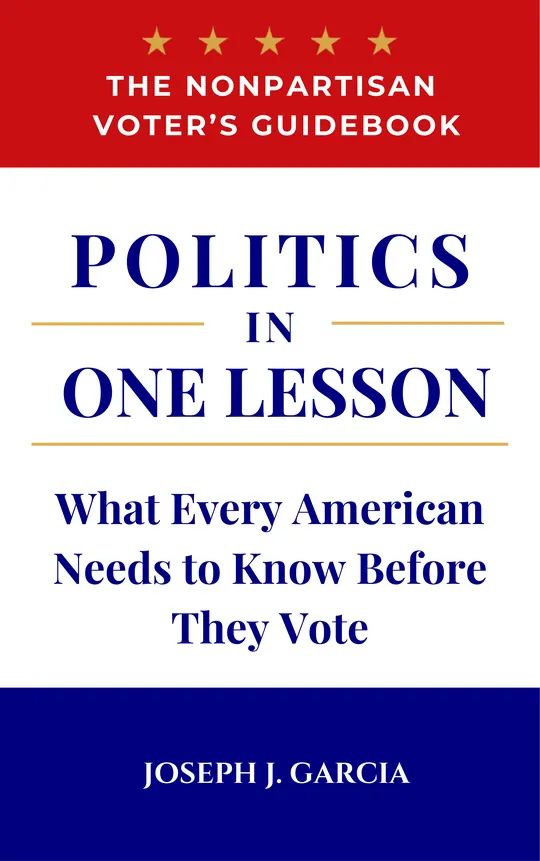
The Nonpartisan Voter's Guidebook
What every American needs to know before they vote.
Millions of Americans follow politics, yet many walk out of the voting booth still unsure they made the right choice. This book gives you one simple, powerful framework that cuts through the noise, spin, and partisan talking points — so you can evaluate any political issue with clarity and confidence.
One Lesson.
Every Issue.
Both Sides.
Politics in One Lesson gives you one simple, powerful framework that cuts through the noise, spin, and partisan talking points. It shows you exactly how to evaluate any political issue with clarity and confidence — so you can make up your own mind and vote with confidence.
One clear framework to analyze any political debate.
What Democrats and Republicans genuinely stand for.
Who benefits and who pays for every major policy.
How to spot spin, misleading statistics, and false choices.
A practical Quick Reference Guide for Election Day.
This book makes the genuine Democratic argument and the genuine Republican argument, each as their most thoughtful supporters would make it. Understanding a position isn't the same as agreeing with it — but you can't think clearly about an issue you don't actually understand.
The genuine Democratic argument, made fairly — not by its critics, but by its strongest advocates.
The genuine Republican argument, made fairly — not by its critics, but by its strongest advocates.
What comes out of your paycheck, and why both parties fight about it.
How it grew, and how to grade any promise to fix it.
Where it comes from, and who it hits hardest.
Who pays, who decides, and what both parties actually want.
The debate isn't about guns. It's about who controls them.
The economy creates jobs. Politicians take credit.
What the debate is actually about, and what both sides leave out.
Why protecting one industry always costs another.
Who benefits, who pays, and who has authority to decide.
Both parties claim to be the party of freedom — and mean different things.
Who deserves help, and what it costs everyone else.
The fight about money, curriculum, and who has the final say.
The most consequential appointments most voters never think about.
The transition that divides the country, and what it actually costs.
What the foreign policy debate is actually about.
The most important elections are the ones with the lowest turnout.
Why your vote for who you want can elect who you like least.
A toolkit for evaluating anything a politician promises you.
What the fight is really about: whether healthcare should work more like a guaranteed public service, or more like a competitive market.
Treating access to medical care as a basic protection government should help guarantee — pointing to coverage gaps and medical debt as evidence a larger public role can work better.
More choice and less regulation — arguing care is expensive partly because government has insulated consumers from real prices and restricted competition.
Broader coverage usually means higher taxes and tighter price controls. A looser market preserves choice, but can leave families exposed to bills they can't carry. The real question: which failure do you fear more?
One lesson. Twenty issues. No spin, no jargon, no side left out.
Get the Book on Amazon